
Battery systems for autonomous platforms
Mission-Ready Power.
Engineered to Perform.
VoltaSphere designs and manufactures configurable battery packs for unmanned and autonomous applications. From cell selection and BMS integration to validation and production, we tailor each pack to your mission, target market and supply-chain requirements, including NDAA compliance options for U.S. programs.
What we supply
Battery systems built for the mission
No two platforms have the same power profile. We work with OEMs and system integrators to balance energy, power, weight, cycle life, safety and integration requirements, without tying every project to a single cell chemistry or supplier.
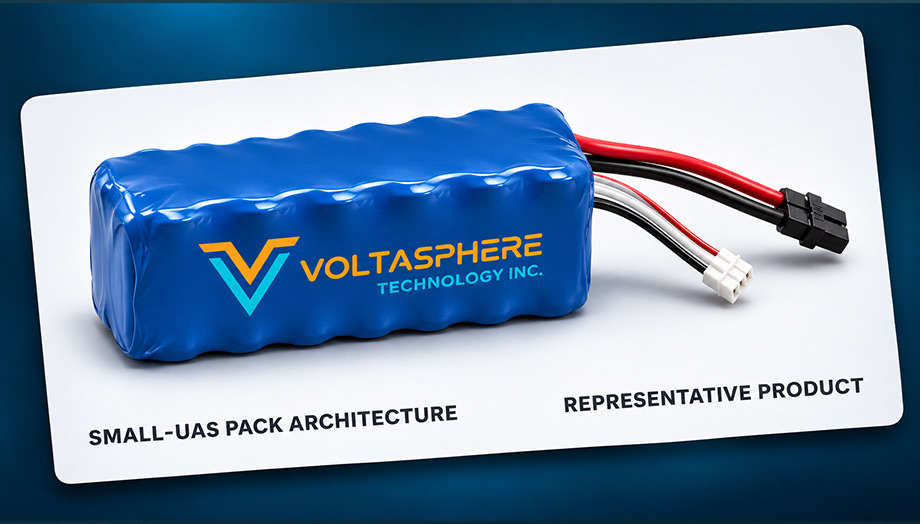
4S / 6S-class high-power packs
Pouch and cylindrical-cell approaches for compact unmanned aircraft, configured to the airframe and duty cycle.
14S / 18S-class battery solutions
For spraying, spreading, mapping and other demanding field operations, with attention to uptime, serviceability and cycle-life economics.
Application-specific engineering
UGVs, USVs, UUVs and other specialized autonomous platforms. Scope and qualification are defined program by program.
From your design to co-development
Sourcing, BMS integration, design for manufacturing, prototyping, validation and production support.
Regional requirements
Designed for your market. Built for your requirements.
Different markets and customer programs carry different safety, sourcing and procurement rules. We tailor battery design, component selection, manufacturing route, testing and documentation to each. For customers seeking NDAA-compliant batteries, we assess non-PRC and other program-eligible sourcing options and evaluate product-specific compliance and availability against the applicable requirements.
Production footprint
Taiwan production today. U.S. manufacturing next.
Our engineering and manufacturing operations are based in Taiwan. We are actively pursuing qualified U.S. contract manufacturing for customer programs as the first localization step, followed by a planned VoltaSphere-operated U.S. production facility targeted for Q3 2027, subject to financing, demand, site readiness and qualification.
Bring us the mission. We'll engineer the power.
Tell us about your platform, duty cycle, power requirements and sourcing constraints. We will help identify a practical path from specification to production.
Frequently asked questions
Short answers to the questions we hear first
Does VoltaSphere offer NDAA-compliant battery packs?
Yes, as program-specific options. For customers seeking NDAA-compliant batteries we tailor product design, cell and component sourcing, and manufacturing arrangements to the applicable U.S. defense procurement requirements, and complete the necessary provenance verification before a configuration is represented as NDAA-compliant. Eligibility is assessed per configuration and program.
Where are VoltaSphere batteries manufactured today?
In Taiwan. Engineering and manufacturing operations are based in Taipei, Taiwan.
When will U.S. production be available?
U.S. production is a planned capability, not a current one. The first step is qualifying U.S. contract manufacturing partners for selected customer programs. A VoltaSphere-operated U.S. facility is targeted for Q3 2027, contingent on financing, customer demand, site and permitting readiness, and product and process qualification.
Can you build to our existing design?
Yes. We produce to customer-controlled specifications (build-to-print) and can also qualify alternative cells and components, improve manufacturability and manage sourcing. Co-developed designs are the other route.